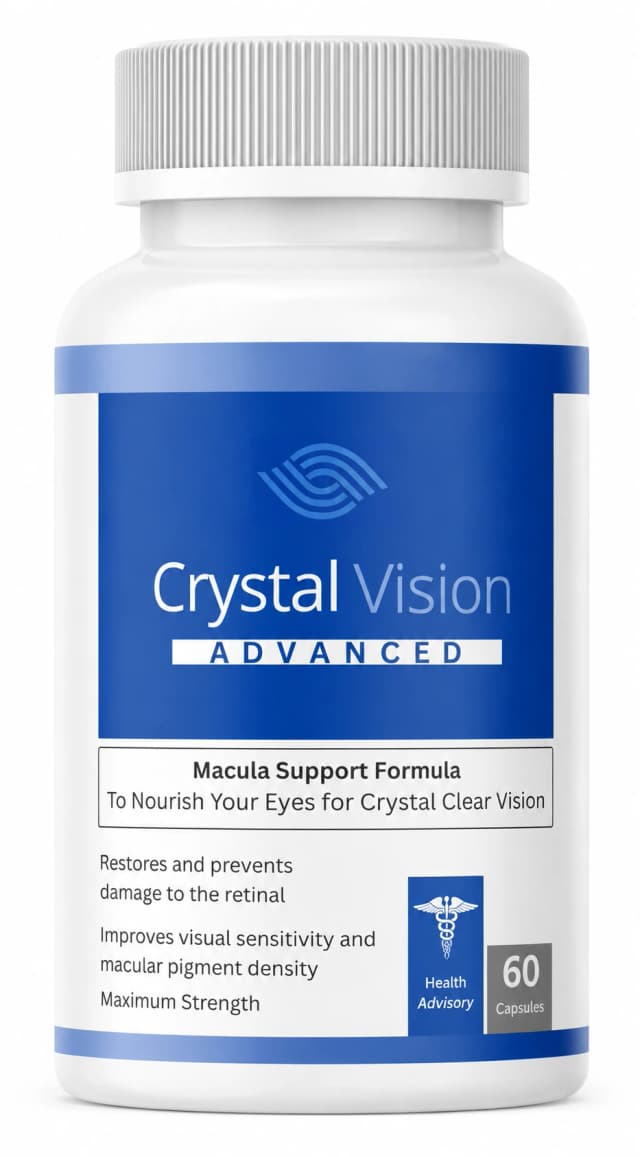
FSP Quick Verdict
Decent starting point for foundational eye nutrition. Missing zeaxanthin and dose transparency keep it from competing with serious formulas.
Crystal Vision does a few things correctly. Lutein is the right lead ingredient — it is the most evidence-backed carotenoid for macular pigment density and blue light filtration. Bilberry brings anthocyanin antioxidant support for retinal tissue. Vitamins C and E with zinc and copper are aligned with the AREDS2 micronutrient framework, the most cited eye health supplement study ever conducted. And the price — $0.95 per serving — is the most competitive we have reviewed in this category. That is the honest case for it. The honest case against: there is no zeaxanthin, which is lutein's partner in the macula and part of every rigorous eye health formula. The exact milligram doses are not publicly confirmed — you cannot verify whether the lutein dose reaches even the 10mg minimum associated with measurable macular effects. There is no independent third-party potency testing. For $0.95/serving, Crystal Vision is not a scam — but it is not a complete formula either.
formula
6.5
transparency
5.0
verification
4.5
value
9.0
practical
7.5
What Is Crystal Vision?
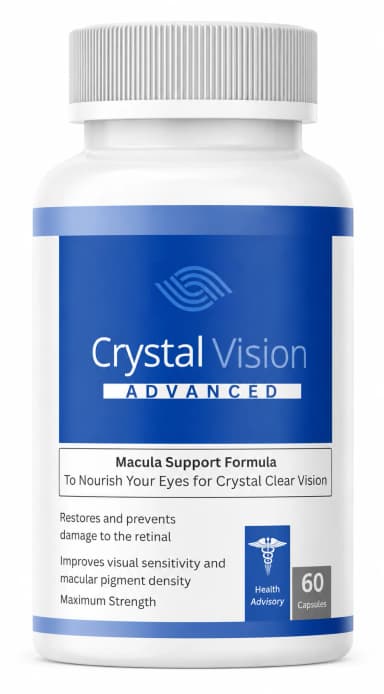
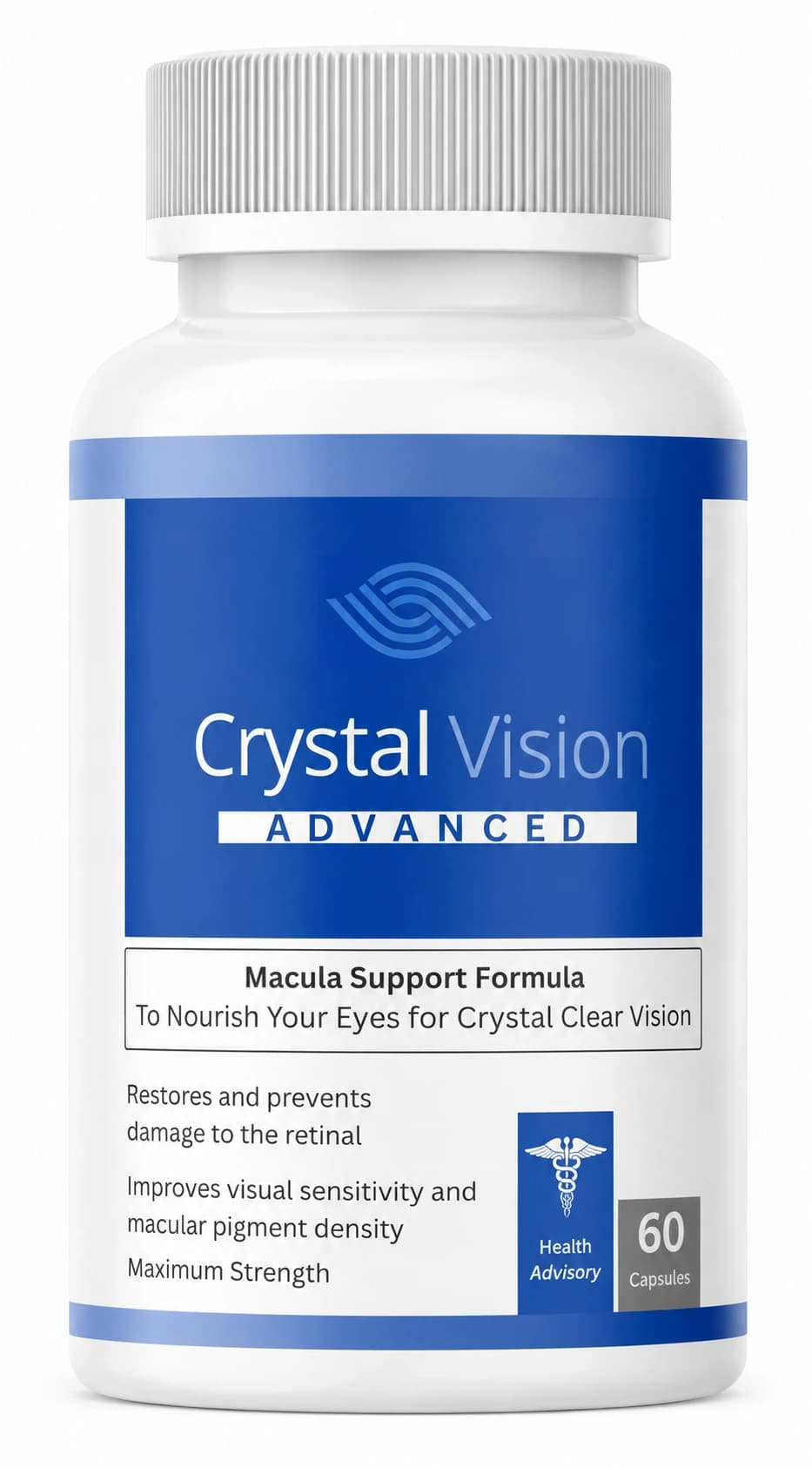
Crystal Vision is a daily eye health supplement from MDS Labs (a Reventek® brand), sold through ClickBank distribution. It is formulated for people dealing with digital eye strain, age-related visual decline, and blue light exposure — the increasingly common complaints of anyone who spends significant time in front of screens or who is over 40 and noticing changes in visual sharpness or light sensitivity.
The formula uses seven ingredients: lutein, bilberry extract, eyebright herb, vitamins C and E, zinc, and copper. All plant-derived. All confirmed vegan, gluten-free, and non-GMO. Made in a GMP-certified facility in the USA. Two capsules per day is the entire protocol — no timing window, no stacking, no loading phase.
What it is not: an AREDS2 formula. The AREDS2 study — the most important clinical trial in eye supplement history — used a specific combination including both lutein and zeaxanthin. Crystal Vision omits zeaxanthin. This matters, and the ingredient breakdown section explains why in detail.
Who is Crystal Vision for?
Adults over 40 looking for affordable daily eye nutrition — lutein for macular pigment, bilberry for retinal antioxidant support, vitamins and minerals for baseline eye health. Not appropriate as a replacement for prescribed AREDS2 supplementation in people diagnosed with intermediate AMD. Not a substitute for routine eye examinations. Cannot correct refractive errors.
Score Breakdown
FSP v2.1 weights: Formula 35% · Transparency 25% · Verification 20% · Value 12% · Practical 8%
Composite FSP score: 4.9/10. Editorial score: 6/10. Value (9.0) and practical (7.5) scores are genuine strengths. Formula (6.5), transparency (5.0), and verification (4.5) reflect real limitations that a more complete, independently tested formula would address.
Red & Green Flags
Supplement Facts
Two capsules (1 serving) per day. 30 servings per bottle. Take with water. No specific timing requirement. Below are the confirmed ingredients. Note: exact milligram quantities per ingredient are not publicly confirmed — the clinical reference ranges are shown so you can assess what the doses would need to be to hit evidence thresholds.
Transparency note: Individual ingredient doses are not reproduced in any publicly accessible product documentation we could locate. The table below shows confirmed ingredients and their evidence-based clinical ranges for reference.
| Ingredient | Confirmed | AREDS2 Dose | Evidence |
|---|---|---|---|
| Lutein | ✓ Present | 10 mg | Strong |
| Bilberry Extract | ✓ Present | N/A | Moderate |
| Eyebright (Euphrasia) | ✓ Present | N/A | Limited |
| Vitamin C | ✓ Present | 500 mg | Strong |
| Vitamin E | ✓ Present | 400 IU | Strong |
| Zinc | ✓ Present | 80 mg | Strong |
| Copper | ✓ Present | 2 mg | Strong |
| Zeaxanthin | ✗ Absent | 2 mg | Strong |
Ingredient Breakdown
Seven ingredients. Here is what each one does, what the clinical evidence actually says, and where the gaps are. For deeper context on any individual ingredient, the ingredient database has full breakdowns.
The right call as the lead ingredient. Lutein is a carotenoid that concentrates specifically in the macula — the central region of the retina responsible for sharp detail and colour discrimination. It acts as a natural optical filter for high-energy blue light and as an antioxidant within macular tissue. The AREDS2 Research Group (2013, JAMA Ophthalmology) used 10mg daily and found supplementation associated with a 25% reduction in progression to advanced AMD in a high-risk population. ConsumerLab's review of eye supplement evidence established 10mg as the minimum effective threshold for measurable macular pigment optical density changes. Without confirmed doses, we cannot verify Crystal Vision meets this threshold.
Bilberry Extract (Vaccinium myrtillus) — (dose unconfirmed)
●●○Moderate EvidenceBilberry is the strongest ancillary ingredient in this formula. Its anthocyanin content — the compounds responsible for its deep blue-purple pigment — have demonstrated protective effects on retinal photoreceptor cells under oxidative and blue light stress in both animal and in vitro research. Ogawa et al. (2014, Journal of Agricultural and Food Chemistry) found bilberry and lutein extracts reduced reactive oxygen species and protected photoreceptors from blue LED light-induced damage. The limitation: most positive human trial data comes from small studies. Effective bilberry extract doses in human research are typically 120–160mg of standardised extract; without a confirmed dose, the inclusion cannot be verified as functional.
Eyebright (Euphrasia officinalis) — (dose unconfirmed)
●○○Limited EvidenceEyebright has a long history in European traditional medicine for eye complaints — redness, irritation, conjunctivitis. The mechanistic rationale is anti-inflammatory: iridoid glycosides and flavonoids in eyebright have shown anti-inflammatory activity in cellular models. Human RCT evidence, however, is sparse. The strongest published data is a non-randomised observational study. A Cochrane-level evaluation of eyebright for eye conditions has not been conducted. Its presence adds traditional credibility and some anti-inflammatory plausibility, but it is not a clinically validated ingredient in the way lutein is.
Vitamin C — (dose unconfirmed)
●●●Strong EvidenceVitamin C is an essential antioxidant and the primary water-soluble antioxidant in ocular tissue. The lens of the eye has one of the highest concentrations of vitamin C in the body — it protects crystallin proteins from oxidative damage and maintains lens transparency. AREDS2 used 500mg daily. Standard dietary intake is approximately 75–90mg; supplementation to 500mg provides meaningful additional antioxidant load to ocular tissue. Whether Crystal Vision's dose approaches 500mg in a 2-capsule serving covering six other ingredients is uncertain.
Vitamin E — (dose unconfirmed)
●●●Strong EvidenceThe fat-soluble antioxidant partner to vitamin C. Vitamin E (as alpha-tocopherol) protects retinal cell membranes from lipid peroxidation — a key mechanism in photoreceptor degeneration. AREDS2 used 400 IU daily. For reference, a 2-capsule serving containing seven ingredients would need significant vitamin E concentration to approach 400 IU — this is physically possible but space-constrained.
Zinc — (dose unconfirmed)
●●●Strong EvidenceZinc is concentrated in the retina and choroid — higher than almost anywhere else in the body. It is required for rhodopsin synthesis (the photopigment essential for night vision), vitamin A metabolism, and antioxidant enzyme activity. AREDS2 used 80mg zinc oxide daily. This is a notably high dose — the NIH tolerable upper intake level for zinc is 40mg, which is why AREDS2 paired it with copper at 2mg to prevent copper-deficiency anaemia from high zinc intake. Crystal Vision includes copper, which confirms awareness of this interaction. Whether the zinc dose reaches or approaches 80mg in this formula is unknown.
Copper — (dose unconfirmed)
●●●Strong EvidenceCopper's role here is protective rather than direct: high zinc supplementation inhibits copper absorption in the gut. Without co-supplemented copper, high-zinc eye formulas can cause copper-deficiency anaemia over time. AREDS2 used 2mg daily to counteract 80mg zinc. Crystal Vision's inclusion of copper demonstrates that the formulator understood this interaction — a positive signal about the formula's design intent.
What's missing — and why it matters
Zeaxanthin (absent). Lutein and zeaxanthin are the only two carotenoids that accumulate in the human macula. Lutein concentrates in the peripheral macula; zeaxanthin concentrates in the central fovea — the area responsible for the sharpest, most detailed vision. AREDS2 used 2mg zeaxanthin daily alongside lutein. Every major competitor formula includes both. Without zeaxanthin, Crystal Vision provides only half of the carotenoid macular pigment support that the clinical evidence calls for.
Omega-3 fatty acids (absent).The updated AREDS2 protocol explored DHA and EPA supplementation for AMD. While the original AREDS2 primary analysis did not show additional benefit from omega-3s, subsequent subgroup analyses suggested potential benefit for certain populations. Most premium eye formulas include them. At Crystal Vision's price point, their absence is understandable — but worth noting if omega-3 eye health support is a priority.
Lab & Verification
GMP Certification
Certified
GMP (Good Manufacturing Practices) covers facility hygiene, process controls, and record-keeping. It is the regulatory minimum for US dietary supplement manufacturers. It does not verify ingredient potency, identity, or purity in the finished product.
Made in USA
Confirmed
Manufactured in an FDA-registered US facility. Positive — US-manufactured supplements are subject to FDA GMP regulations, providing baseline quality assurance.
NSF / Labdoor / USP
Not held
No independent third-party potency or purity verification from any recognised certification programme. Without this, the actual ingredient doses cannot be independently confirmed. This is the most significant quality gap for a product citing AREDS2 research.
Certificate of Analysis
Not published
No batch-level COA is publicly available. COAs would provide at minimum identity and potency data for raw ingredients. Their absence reinforces the transparency concern around actual doses.
Bottom line on verification: GMP certification is the floor, not the ceiling. The eye supplement market contains products where labelled doses and actual doses diverge significantly — ConsumerLab testing has found this repeatedly. For a supplement making AMD-adjacent claims, independent potency testing would be the minimum credibility standard. Crystal Vision does not currently meet it.
Claim Audit
Marketing claims from Crystal Vision product pages, assessed against published evidence.
How to Take It
Daily Protocol
2 capsules with water
The fat-soluble ingredients — lutein and vitamins E — absorb better when taken with a meal containing dietary fat. Avocado, olive oil, eggs, or nuts alongside breakfast will improve carotenoid bioavailability meaningfully. This is not a minor point: lutein absorption can increase 3–5× when taken with a fat-containing meal versus fasted.
Consistency
Daily, no cycling needed
Eye health supplements are not acute performance boosters — they work through gradual accumulation in macular tissue. Lutein loading in the macula occurs over weeks to months of consistent daily intake. Missing occasional days is not critical; going weeks without is. Set a daily reminder.
What to expect
Gradual, not immediate
Some users report reduced eye fatigue and improved light comfort within 4–6 weeks. Measurable macular pigment density changes in research studies typically require 3–6 months of consistent supplementation. Crystal Vision is not a short-term intervention — it is a long-term nutritional support strategy.
Consider adding
Zeaxanthin (separate supplement)
Given the absence of zeaxanthin in this formula, users who want to complete the macular pigment carotenoid support can add a standalone zeaxanthin supplement (2–4mg daily). This partially addresses Crystal Vision's biggest formula gap without switching products.
vs. Competitors
Eye health supplements compared on ingredients, AREDS2 alignment, third-party testing, and price. See all eye health supplement reviews for the full category list.
| Product | Lutein | Zeaxanthin | Bilberry | 3rd-Party | Price/Serving |
|---|---|---|---|---|---|
| Crystal Vision ★ | ✓ (dose ?) | ✗ Absent | ✓ | GMP only | $0.95 |
| Performance Lab Vision | 10mg (Lutemax) | 2mg | ✗ | Informed Sport | $1.83 |
| Bausch + Lomb Ocuvite | 10mg | 2mg | ✗ | None | $0.67 |
| PreserVision AREDS2 | 10mg | 2mg | ✗ | USP Verified | $0.52 |
| EyePromise Screen Shield | 15mg | 6mg (meso) | ✓ | NSF Certified | $1.65 |
Crystal Vision is the cheapest option here — and the only one without zeaxanthin or independent third-party testing. PreserVision AREDS2 at $0.52 is USP Verified and matches AREDS2 precisely. For anyone specifically managing AMD risk, PreserVision AREDS2 is the more defensible choice despite being a different product type.
Products at a Glance
Pros & Cons
Strengths
- Lutein is the correct lead ingredient for macular pigment and blue light filtration
- Bilberry extract provides anthocyanin antioxidant support — backed by retinal protection research
- Vitamins C, E, zinc, copper align with AREDS2 micronutrient framework
- Copper included to offset zinc — correct and considered formulation detail
- Vegan, gluten-free, non-GMO — all three confirmed
- $0.95/serving — the most competitive price point in the eye health supplement category
- GMP certified, Made in USA
- Simple 2-capsule daily protocol — no timing complexity
Limitations
- No zeaxanthin — lutein's partner in the macula, present in every AREDS2-aligned formula
- Exact ingredient doses not publicly disclosed — cannot verify against clinical thresholds
- No independent third-party potency testing (no NSF, Labdoor, USP, or equivalent)
- Eyebright has limited human RCT evidence — included on traditional use, not clinical validation
- No vitamin A — important for night vision and not supplied by other listed ingredients
- No omega-3 fatty acids — increasingly recommended in comprehensive eye health formulas
- ClickBank distribution — no direct manufacturer customer support channel
Safety & Side Effects
✓ Lutein and Carotenoids
Lutein is well-tolerated at supplement doses up to 20mg daily. At very high chronic intakes (>20mg/day), carotenodermia — a harmless yellowing of the skin — has been reported but is not a safety concern. At the doses likely present in this formula, no adverse effects are expected.
⚡ Zinc and Copper
Zinc supplementation above 40mg daily (the NIH tolerable upper intake level) can suppress copper absorption over time, leading to copper-deficiency anaemia. Crystal Vision includes copper for this reason — the interaction is known and accounted for. Users taking other zinc-containing supplements should count their total zinc intake. The World Health Organization notes that high zinc intake can also impair immune function at sustained doses above 40mg.
⚡ Vitamin E
Vitamin E at doses above 400 IU daily has been associated with increased bleeding tendency and may interact with anticoagulant medications (warfarin, aspirin at therapeutic doses). If you take blood thinners, discuss vitamin E supplementation with your prescribing doctor before starting.
⚡ Eyebright
Eyebright is generally well-tolerated as an oral supplement. Topical eye use of eyebright preparations carries contamination risk and is not recommended. At oral supplement doses, no significant adverse effects are documented in the literature, though its long-term safety data is thin.
🚫 Not Appropriate For
Crystal Vision is not a treatment for any eye disease, including AMD, cataracts, glaucoma, or diabetic retinopathy. Anyone who has been diagnosed with an eye condition should consult an ophthalmologist before adding any supplement. This product does not replace prescribed treatment, corrective lenses, or professional eye care. Not recommended during pregnancy or nursing without medical advice.
Price & Value
1 bottle (30 servings)
$28.50 ($0.95/serving)
Standard single purchase
Annual cost (daily use)
~$347/year
12 bottles at single-bottle pricing
vs. PreserVision AREDS2
$0.52/serving
USP verified, full AREDS2 formula, includes zeaxanthin
vs. Performance Lab Vision
$1.83/serving
Informed Sport certified, patented Lutemax 2020®, full zeaxanthin
The value case for Crystal Vision is real — $0.95/serving is genuinely the cheapest entry point for a lutein + bilberry + antioxidant supplement. The trade-off is formula completeness and verification. PreserVision AREDS2 at $0.52/serving is cheaper, has zeaxanthin, and carries USP verification. If cost and clinical alignment both matter, PreserVision AREDS2 is the stronger choice despite being less "natural." If natural ingredients and bilberry are specifically your priority and you are comfortable without third-party potency testing, Crystal Vision is a reasonable budget option.
Where to Buy
Official link (via our affiliate)
RecommendedThe ClickBank-distributed official channel. Purchased direct from the supplier, free shipping indicated. ClickBank provides a standardised purchase and refund process.
Buy Crystal VisionAmazon.com
Check carefullyMultiple Crystal Vision products exist on Amazon from different brands — verify the seller is the same MDS Labs formulation if this is the version you want.
Third-party supplement stores
Not recommendedGiven the absence of third-party testing, chain of custody matters. Unverified sellers add storage and handling risk on top of existing quality assurance limitations.
FAQ
FINAL VERDICT · REV-2026-052
6
/10 · FSP EDITORIAL
A usable budget option with real gaps. Right core ingredient, wrong formula depth.
Crystal Vision earns a 6/10. Lutein is the correct lead ingredient. Bilberry adds genuine antioxidant protection for retinal tissue. The AREDS2-inspired micronutrient support — vitamins C, E, zinc, copper — is directionally right. At $0.95 per serving it is the most affordable formula we have reviewed in this category. And it is vegan, gluten-free, non-GMO, and made in the USA.
But the score stops at 6 for reasons that matter. No zeaxanthin — lutein's partner in the macula — is not a minor omission. It is the single most evidence-backed addition to any lutein-based formula. Without confirmed individual doses, every citation to AREDS2 research is unverifiable against this specific product. And without third-party potency testing, you are taking the manufacturer's word on what is actually in each capsule. For anyone serious about supporting long-term eye health, these gaps are real. For someone looking for an affordable daily eye supplement with foundational lutein and antioxidant support — and who understands what they are and are not getting — Crystal Vision is a reasonable starting point at an excellent price.
Research References
- AREDS2 Research Group. (2013). Lutein + zeaxanthin and omega-3 fatty acids for age-related macular degeneration. JAMA. 309(19):2005–15. doi →
- Bernstein PS et al. (2016). Lutein, zeaxanthin, and meso-zeaxanthin: The basic and clinical science underlying carotenoid-based nutritional interventions against ocular disease. Prog Retin Eye Res. 50:34–66. doi →
- Ogawa K et al. (2014). Protective effect of bilberry and lingonberry on blue LED light-induced retinal photoreceptor cell damage in vitro. J Agric Food Chem. 62(15):3396–403. doi →
- Yao Y et al. (2013). Lutein supplementation improves visual performance in Chinese drivers: a randomized controlled trial. Nutrients. 5(12):4886–94. doi →
- Canter PH, Ernst E. (2004). Anthocyanosides of Vaccinium myrtillus (bilberry) for night vision—a systematic review of placebo-controlled trials. Surv Ophthalmol. 49(1):38–50. doi →
- Mrowicka M et al. (2022). Lutein and zeaxanthin and their roles in age-related macular degeneration — neurodegenerative disease. Nutrients. 14(4):827. doi →
- Johnson EJ. (2014). Role of lutein and zeaxanthin in visual and cognitive function throughout the lifespan. Nutr Rev. 72(9):605–12. doi →
- Chew EY et al. (2022). Long-term outcomes of adding lutein/zeaxanthin and omega-3 fatty acids to the AREDS supplements on age-related macular degeneration progression. JAMA Ophthalmol. 140(7):692–98. doi →