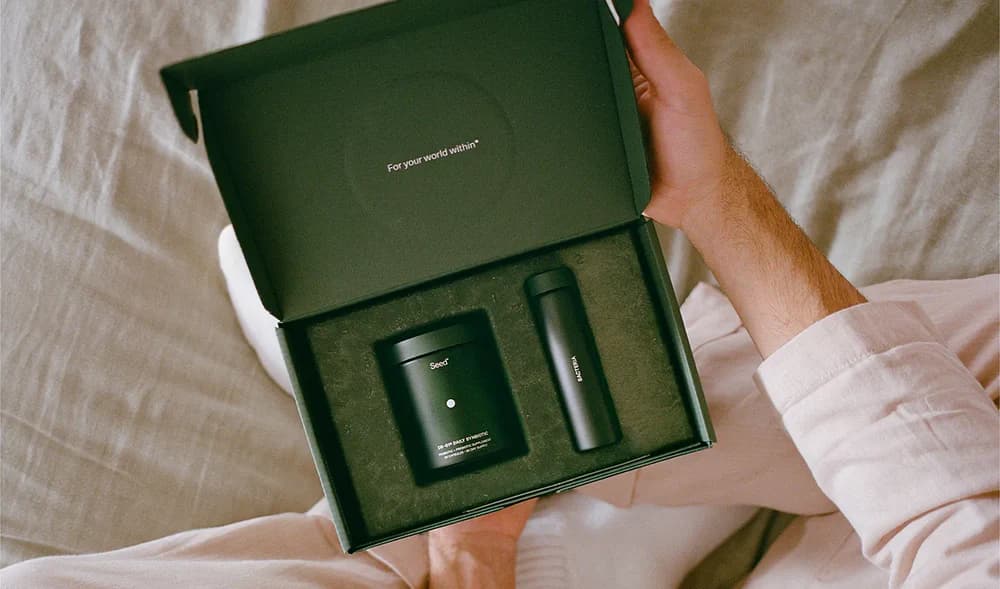
Quick Verdict
What Is Seed DS-01®?
DS-01® Daily Synbiotic is Seed's flagship product and the formulation that built the brand's scientific reputation. It combines 24 probiotic strains with a novel MAPP prebiotic in a ViaCap dual-capsule delivery system — a genuinely differentiated architecture compared to standard probiotic capsules.
The "synbiotic" designation means it contains both probiotics and a prebiotic in one product. Unlike most synbiotics that add fermentable fibres (inulin, FOS) which can worsen bloating in sensitive users, DS-01 uses MAPP (Microbiota-Accessible Polyphenolic Precursors) — 400mg of punicalagins from pomegranate rind concentrate. MAPP is non-fermenting: it modulates the microbiome via polyphenol transformation rather than fermentation.
Seed is a health science company co-founded by Raja Dhir and Ara Katz. The brand's approach to DS-01 is notably rigorous: each of the 24 strains is genomically sequenced, potency is measured by AFU (Active Fluorescent Units) rather than CFU, strains are stability-tested at ambient temperature, and a public Reference Library links each strain to supporting clinical literature.
ViaCap® Delivery Architecture
How DS-01 delivers prebiotic and probiotic to distinct GI locations.
Score Breakdown
Red & Green Flags
Supplement Facts
Serving size: 2 capsules · Servings per container: 30 · 60 capsules total
| Component | Amount | Capsule | Status |
|---|---|---|---|
| MAPP Prebiotic (Pomegranate punicalagins) | 400 mg | Outer | Disclosed |
| Digestive Health Blend (15 strains) | 224 mg / 38.7B AFU | Inner | Disclosed |
| Micronutrient Synthesis Blend (2 strains) | 36 mg / 7.23B AFU | Inner | Disclosed |
| Cardiovascular Health Blend (2 strains) | 13 mg / 4.21B AFU | Inner | Disclosed |
| Dermatological Health Blend (5 strains) | 36 mg / 3.34B AFU | Inner | Disclosed |
| Total Probiotic Potency | 53.6B AFU | Inner | Disclosed |
| Per-strain individual AFU | Undisclosed | Inner | Undisclosed |
Strain Profile
All 24 strains are genomically confirmed. AFU measured by flow cytometry.
Ingredient Analysis
MAPP Prebiotic — 400 mg (Non-fermenting)
●●○Moderate EvidenceA genuinely better prebiotic — no bloat mechanism
Standard synbiotic prebiotics (inulin, FOS, beta-glucan) rapidly ferment in the upper GI, producing hydrogen and methane gas — a common cause of bloating and discomfort. MAPP (Microbiota-Accessible Polyphenolic Precursors) — punicalagins from pomegranate rind — modulates the microbiome through polyphenol metabolism rather than fermentation. Tomás-Barberán et al. (2014) demonstrated punicalagins are transformed by gut bacteria into urolithins, which have prebiotic and anti-inflammatory effects without fermentation byproducts. This is a meaningful formulation advance.
24-Strain Probiotic Blend — 53.6B AFU
●●●Strong EvidenceThe most strain-diverse, evidence-linked commercial probiotic formula
No commercial probiotic has 24 genomically confirmed, individually evidenced strains at 53.6B AFU. The blend isn't arbitrary — each strain is selected for its specific target area (digestive, cardiovascular, micronutrient synthesis, dermatological). Key strains with RCT evidence: L. rhamnosus GG (HRVD113-US equivalent) for digestive health (Szajewska & Kołodziej, 2015 meta-analysis); B. longum BB536 for immune modulation (Nagata et al., 2011 RCT); L. plantarum 299v-equivalent for IBS (Nobaek et al., 2000 RCT); B. lactis BB-12 equivalents for gut immunity.
Clinical Research
Key studies supporting DS-01 ingredient strains. Seed publishes a full Reference Library linking each strain to supporting literature.
Probiotic supplementation with L. rhamnosus and B. lactis: systematic review of digestive outcomes
Szajewska H & Kołodziej M · Alimentary Pharmacology & Therapeutics
Key finding: Meta-analysis of 12 RCTs found L. rhamnosus GG significantly reduced antibiotic-associated diarrhoea incidence (RR 0.48) and duration. Equivalent strain to DS-01's L. rhamnosus HRVD113-US.
Effects of Bifidobacterium longum BB536 intake on common cold symptoms in healthy adults
Nagata S et al. · Journal of Infection and Chemotherapy
Key finding: Double-blind RCT (N=73): BB536 supplementation significantly reduced duration and severity of upper respiratory tract infections vs. placebo. Equivalent strain family to DS-01's B. longum SD-BB536-JP.
A randomized double-blind placebo-controlled trial of a probiotic in irritable bowel syndrome
Nobaek S et al. · American Journal of Gastroenterology
Key finding: L. plantarum 299v (equivalent family to DS-01's L. plantarum SD-LP1-IT) significantly reduced flatulence and improved overall GI symptoms in IBS patients at 12 weeks vs. placebo.
Lab & Verification
Claim Audit
How to Take It
Protocol
Take 2 capsules daily. Start with 1 capsule for the first 3 days to allow your microbiome to adjust.
- Take on an empty stomach or with a light meal. Avoid taking immediately after a heavy meal.
- Take at the same time each day — consistency matters more for probiotic colonisation than exact timing.
- Space from antibiotics by at least 2 hours.
- Do not open, crush, or chew — the acid-resistant inner capsule depends on its shell.
- Consistent daily use for 4+ weeks for full microbiome benefit.
vs. Competitors
| Product | Strains | Potency | Prebiotic | Verification | $/Month |
|---|---|---|---|---|---|
| Seed DS-01 | 24 (genomic) | 53.6B AFU | MAPP 400mg | Genomic + stability | $49.99 |
| Ritual Synbiotic+ | 2 | 11B CFU | FOS 1g | Third-party tested | $39.99 |
| Garden of Life RAW | 34 | 100B CFU | Organic prebiotics | NSF Certified | $49.99 |
| Culturelle Daily | 1 (LGG) | 10B CFU | Inulin | USP Verified | $25.99 |
| Align Probiotic | 1 (BB-12) | 1B CFU | None | None listed | $29.99 |
Prices verified May 2026. CFU vs AFU: AFU counts all viable bacteria; CFU only counts culturable colonies — direct comparison has limitations.
Seed Product Family
All Seed products use ViaCap dual-capsule Co-Biotic delivery architecture.
Pros & Cons
Strengths
- 24 genomically confirmed strains — identity verified, not assumed
- AFU measurement by flow cytometry — more accurate than CFU
- Non-fermenting MAPP prebiotic — avoids the bloat caused by fermentable fibres
- ViaCap dual-capsule delivers prebiotic and probiotic to distinct GI locations
- Shelf-stable without refrigeration — viability confirmed through shelf life
- Third-party tested for pesticides, herbicides, allergens, and contaminants
- Four targeted blends: digestive, cardiovascular, micronutrient synthesis, dermatological
- Public Reference Library linking each strain to supporting clinical evidence
Limitations
- $49.99/month — among the most expensive commercial probiotics
- Per-strain AFU counts undisclosed
- No head-to-head RCT demonstrating superiority over lower-priced alternatives
- No Informed Sport or NSF Certified for Sport (limits use for tested athletes)
- Subscription model — no one-time purchase available through main channel
Safety & Side Effects
DS-01 has an excellent safety profile in healthy adults. Minor initial GI adjustment is common and expected — starting at 1 capsule/day for the first 3 days reduces this.
Increased gas, loose stools, or mild bloating for the first week as your microbiome adjusts to 24 new strains. Start with 1 capsule/day for 3 days before moving to the full 2-capsule dose.
Probiotic supplementation is generally not recommended for individuals with serious immune deficiencies (e.g., post-organ transplant, active chemotherapy, severe neutropenia) without medical supervision. Live bacteria can cause infection in severely compromised immune states.
Antibiotics will kill most probiotic strains. Space by at least 2 hours. DS-01 can and should be continued throughout an antibiotic course — it won't make the antibiotics less effective.
Price & Value
Subscription at $135.35/quarter reduces to $1.50/serving. Amazon pricing may vary. Prices verified May 2026.
Where to Buy
Available on Amazon
$49.99 / 30 servings
Also at seed.com, Target, Sprouts. Prices verified May 2026.
FAQ
Final Verdict
Research References
- Szajewska H, Kołodziej M. (2015). Systematic review with meta-analysis: L. rhamnosus GG in the prevention of antibiotic-associated diarrhoea in children. Alimentary Pharmacology & Therapeutics, 42(10):1149–1157. doi →
- Nagata S et al. (2011). Effects of Bifidobacterium longum BB536 on common cold symptoms in healthy adults. Journal of Infection and Chemotherapy, 17(6):814–820. doi →
- Nobaek S et al. (2000). Alteration of intestinal microflora associated with reduction of abdominal bloating in IBS. American Journal of Gastroenterology, 95(5):1231–1238. doi →
- Tomás-Barberán FA et al. (2014). Ellagic acid metabolism by human gut microbiota: a comparative analysis of in vitro and in vivo studies. Journal of Agricultural and Food Chemistry, 62(23):5441–5445. doi →
- Salminen S et al. (2021). The International Scientific Association for Probiotics and Prebiotics (ISAPP) consensus statement on the definition and scope of postbiotics. Nature Reviews Gastroenterology & Hepatology, 18(9):649–667. doi →