Quick Verdict
FSP v2.1 Verdict — REV-2026-060
The benchmark for transparent sleep supplementation. Four clean ingredients, every dose disclosed, no synthetic melatonin.
Performance Lab Sleep earns its score through honest simplicity. It doesn't try to stack 10 ingredients at unknown doses — it picks four quality actives, discloses every milligram, and backs them with independent certification. The magnesium dose is below clinical range, and $1.47/serving is expensive relative to simpler alternatives. But for consumers who want clean, certified, synthetic-melatonin-free sleep support with full label transparency, this is the standard other products should be measured against.
What Is Performance Lab Sleep?
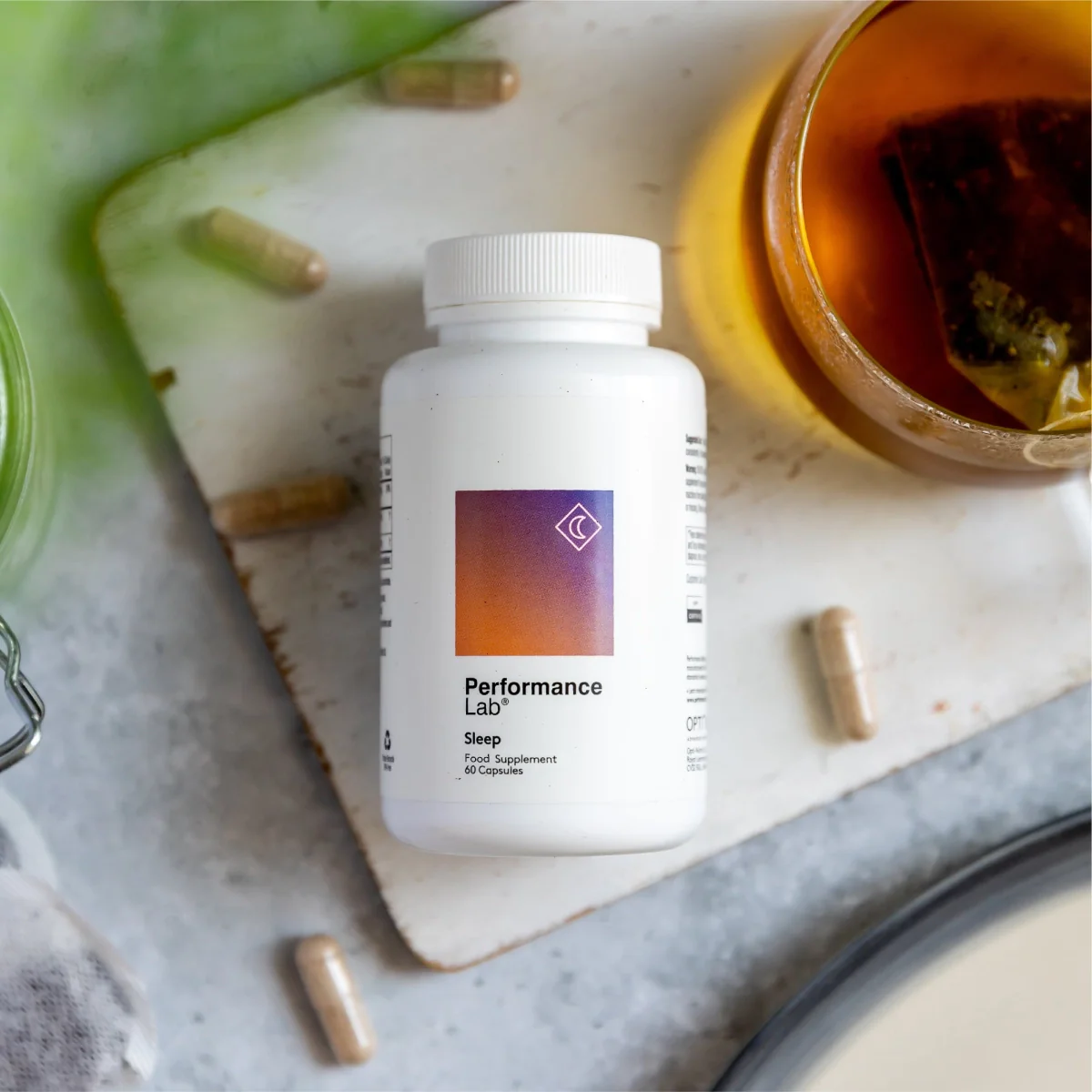
Performance Lab Sleep is a nightly supplement from Performance Lab — a UK-based nutraceutical brand with a reputation for clean, minimal formulations. The product uses four ingredients: CherryPURE® Montmorency tart cherry extract (500mg, 50:1 ratio), L-Tryptophan (200mg), lemon balm extract (200mg), and a NutriGenesis® magnesium blend (100mg bisglycinate + taurate).
The core design principle is avoiding synthetic melatonin. Instead, the formula supports the body's own melatonin synthesis pathway: CherryPURE® provides naturally occurring melatonin from tart cherry, while L-Tryptophan feeds the enzymatic chain that converts tryptophan → 5-HTP → serotonin → melatonin. This is a slower-acting but arguably more physiologically appropriate approach for long-term use.
Performance Lab is a B Corp certified company manufacturing in GMP certified facilities. Performance Lab Sleep specifically holds Clean Label Project certification — a rigorous independent test covering 400+ contaminants. The product is vegan, non-GMO, gluten-free, and soy-free.
Score Breakdown
Red & Green Flags
Supplement Facts
Serving size: 2 NutriCaps® · Servings per container: 30
| Ingredient | Amount | Clinical Range |
|---|---|---|
| Magnesium (Bisglycinate, Taurate, NutriGenesis®) | 100 mg | 200–400 mg |
| CherryPURE® (Montmorency Tart Cherry, 50:1) | 500 mg | 480–500 mg |
| L-Tryptophan | 200 mg | 150–300 mg |
| Lemon Balm Extract | 200 mg | 300–600 mg |
Other ingredients: NutriCaps® Pullulan capsule, Nu-FLOW® Rice Concentrate. No synthetic melatonin, no artificial fillers.
Ingredient Breakdown
CherryPURE® Tart Cherry — 500 mg (50:1)
●●○Moderate EvidenceThe headline ingredient — on target at 500mg
Montmorency tart cherry is one of the few food sources with measurable melatonin content, plus anthocyanins and tryptophan. Howatson et al. (2012) found 480mg concentrate significantly raised urinary melatonin levels and improved sleep duration and quality in healthy adults. Pigeon et al. (2010) showed tart cherry juice reduced insomnia severity. The 50:1 ratio means 500mg CherryPURE® equals 25g whole cherry — a meaningful concentration. This is the strongest ingredient in the formula.
L-Tryptophan — 200 mg
●●○Moderate EvidenceSolid precursor dose for melatonin pathway support
Tryptophan is the dietary precursor to 5-HTP → serotonin → melatonin. Richard et al. (2009) confirmed 1g L-tryptophan improved morning alertness and sleep quality in a double-blind trial. At 200mg, Performance Lab Sleep is below the 1g typically used in sleep studies — but the dose is additive with the direct melatonin contribution from CherryPURE®. A 2015 Cochrane review found tryptophan supplementation meaningfully reduces sleep latency.
Lemon Balm Extract — 200 mg
●●○Moderate EvidenceUnderdosed vs. RCT data — useful adjunct nonetheless
Lemon balm (Melissa officinalis) inhibits GABA-transaminase, prolonging GABAergic inhibitory signalling. Cases et al. (2011) used 600mg and found significant insomnia relief. Kennedy et al. (2004) showed 300mg reduced anxiety and improved mood. Performance Lab Sleep's 200mg is below these benchmarks, though the combination with tart cherry and tryptophan may compensate. The contribution here is anxiolysis and relaxation rather than direct sleep induction.
Magnesium — 100 mg (NutriGenesis® Bisglycinate + Taurate)
●●○Moderate EvidencePremium form, underdosed for primary sleep effect
Magnesium supports GABA receptor function and reduces cortisol. Abbasi et al. (2012) found 500mg supplementation improved insomnia, sleep efficiency, and early waking. The effective range is 200–400mg. Performance Lab Sleep's 100mg is below clinical threshold for primary sleep benefit, but NutriGenesis® bisglycinate + taurate are among the best-absorbed forms — taurate specifically has documented CNS uptake superiority. At 100mg it acts as a cofactor, not a primary driver.
Lab & Verification
Clean Label Project tests for 400+ contaminants including heavy metals (lead, arsenic, cadmium), pesticide residues, plasticisers (BPA, phthalates), and mycotoxins. This is a more comprehensive contaminant screen than most supplement certifications. The absence of Informed Sport certification limits its appeal for competitive athletes — drug-tested athletes should be aware.
Claim Audit
How to Take It
Brand Protocol
Take 2–4 NutriCaps® 30 minutes before sleep. Use daily and consistently for best results.
The 2–4 capsule flexibility is a practical advantage. Start at 2 capsules and increase to 4 if needed. For users with sensitive systems, 2 capsules of Performance Lab Sleep is typically sufficient.
Evidence-based timing notes
- L-Tryptophan: best absorbed in absence of other large amino acids. Take 30–60 min before a light meal or on an empty stomach.
- CherryPURE® tart cherry: onset for melatonin elevation is 60–90 min — start earlier than 30 min if sleep latency is the primary issue.
- Magnesium glycinate: effects are cumulative. Consistent daily use matters more than precise timing.
- Lemon balm: acute anxiolytic effect within 60 min. Clinically useful for pre-sleep rumination.
vs. Competitors
| Product | Ingredients | Syn. Melatonin | Full Label? | Certification | $/Serving |
|---|---|---|---|---|---|
| Performance Lab Sleep | 4 (all disclosed) | No | Yes | Clean Label Project | $1.47 |
| Nested Naturals Luna | 8 (all disclosed) | 6 mg | Yes | Third-party (unspecified) | $0.73 |
| Seed PM-02 | 10+ (partial) | 0.5 mg bioid. | Partial | ISO 17025 | $1.17 |
| YuSleep | 10 (1 disclosed) | 0.9 mg | No | None | $2.30 |
| OLLY Sleep | 3 (partial) | 5 mg | Partial | None listed | $0.50 |
Prices verified May 2026.
Products at a Glance
Pros & Cons
Strengths
- Full supplement facts — every dose disclosed
- No synthetic melatonin — no tolerance or grogginess risk
- Clean Label Project certified (400+ contaminants tested)
- NutriGenesis® magnesium: premium bisglycinate + taurate forms
- CherryPURE® 500mg directly matches Howatson et al. (2012) study dose
- Vegan-certified NutriCaps® pullulan capsule — no gelatin
- 2–4 capsule flexibility for dose titration
- B Corp certified company
Limitations
- Magnesium 100mg below clinical effective range (200–400mg)
- $1.47/serving is 2× the price of transparent alternatives like Luna
- 30-day guarantee applies to first order only — subsequent orders 14 days unopened
- No Informed Sport or NSF Certified for Sport badge
- Lemon balm 200mg below RCT doses (300–600mg)
- No subscription discount available on Amazon
Safety & Side Effects
Performance Lab Sleep has an excellent safety profile. No synthetic melatonin eliminates the principal side effect concern associated with most sleep supplements. All four ingredients are well-characterised at these doses.
L-Tryptophan contributes to serotonin synthesis. Combined with MAOIs or SSRIs, this can theoretically increase serotonin syndrome risk, though at 200mg the risk is substantially lower than with 5-HTP. Consult a doctor if on serotonergic medications.
Lemon balm has mild sedative properties. Combined with benzodiazepines, alcohol, or sleep aids, additive sedation is possible. At 200mg this risk is minimal but worth noting.
Magnesium can reduce absorption of some antibiotics (tetracyclines, fluoroquinolones) when taken simultaneously. Space by at least 2 hours if on these medications.
All four ingredients are well-tolerated in healthy adults at these doses. No dependency, withdrawal, or tolerance profile. Safe for long-term nightly use.
Price & Value
| Option | Price | Per Serving | Saving |
|---|---|---|---|
| One-time (1 bottle) | $44.00 | $1.47 | — |
| Monthly subscription | $39.60 | $1.32 | 10% off |
| Smart sub (4 bottles) | $132.00 | $1.10 | 25% off |
Prices from performancelab.com. Prices verified May 2026.
Where to Buy
Available on Amazon
$44.00 / 30 servings
Prime shipping · Easy returns. Prices verified May 2026.
FAQ
Final Verdict
FSP v2.1 — REV-2026-060
Recommended. The cleanest sleep formula at this price point.
Performance Lab Sleep earns an 8/10 for doing what most sleep supplements don't: disclosing everything, certifying independently, and avoiding synthetic melatonin. The magnesium dose deserves to be doubled, and at $1.47/serving it asks a premium that not every consumer can justify. But for those who want a genuinely clean, certified, science-grounded product — and are happy to pair it with a separate 200–300mg magnesium glycinate supplement if needed — this is the most defensible choice in its category.
Buy on AmazonResearch References
- Howatson G et al. (2012). Effect of tart cherry juice on melatonin levels and enhanced sleep quality. European Journal of Nutrition, 51(8):909–916. doi →
- Pigeon WR et al. (2010). Effects of tart cherry beverage on sleep of older adults with insomnia. Journal of Medicinal Food, 13(3):579–583. doi →
- Richard DM et al. (2009). L-tryptophan: basic metabolic functions, behavioral research and therapeutic indications. International Journal of Tryptophan Research, 2:45–60. doi →
- Cases J et al. (2011). Pilot trial of Melissa officinalis for mild-to-moderate anxiety and sleep disturbances. Mediterranean Journal of Nutrition and Metabolism, 4(3):211–218. doi →
- Kennedy DO et al. (2004). Anxiolytic effects of lemon balm in healthy volunteers. Psychosomatic Medicine, 66(4):607–613. doi →
- Abbasi B et al. (2012). Magnesium supplementation and primary insomnia in elderly. Journal of Research in Medical Sciences, 17(12):1161–1169. doi →
- Xie L et al. (2013). Sleep drives metabolite clearance from the adult brain. Science, 342(6156):373–377. doi →
- Brzezinski A et al. (2005). Effects of exogenous melatonin on sleep: a meta-analysis. Sleep Medicine Reviews, 9(1):41–50. doi →